Showing posts with label Website Promotion. Show all posts

Seven Tips to Maintain Your Website Reputation

Seven Tips to Maintain Your Website Reputation - In order to succeed and combat the competitive online world, you need to maintain a good reputation online. A good reputation does not only require a good website design but a lot more to build confidence, to grow sales and ultimately leads to better revenues and higher profitability.

In today's Internet buzz nasty rumors, wrong opinions and incorrect news spread rapidly and if not taken timely action to handle the news properly, you may face a serious threat to your online business and credibility.

Here are some simple measures you can take to maintain your website's reputation:


http://media.entireweb.com/images/ads/newsletter/issue_591/mainarticle_image.jpg


1. Respond to customers

Being open and responsive to customers is an important part of creating a positive impression and managing your website's reputation. If someone asks you a question, answer it there or through e-mail. Be quick in addressing your customer issues before the word spreads.

2. Answer the negative comments humbly

Be real, not everyone is satisfied with your work and services. If these people are among the ones spreading negative comments about you for whatever reason like delayed service or unfriendly attitude, answer them instantly to terminate the issue right there!

Be very polite when putting your point of view in front of such people and you'll sure succeed in saving your reputation. Answering negative remarks modestly can be a great way of turning a bad situation into positive one.

3. Create official online profiles

Create your own platform for users to share their experiences they've had with you. Create your own profiles and websites complete with the kind of information you actually want to be available about you. Let users communicate with each other and comment about your products or services, whether positive or negative.

4. Report stolen material from you

It's very well possible that online competitors may steal material from your website to increase their ranking and traffic. This may lose your credibility among your users, making you "not-so-unique" in their eyes. To control such theft, you can report their site through strict action.

5. Write blogs

Writing blog posts are extremely effective in promoting your business. Through blog reviews and blog comments, you even increase your chance of getting high traffic volumes to your website.

If you or any of the experts in your business have important knowledge like instructions, guidelines, tips and trick that can be useful for the users, share them through writing blog posts, let say you write blog for "basic tips for web design". This will greatly enhance your online reputation.

6. Optimize For Search Engines

Majority of the internet users accept results from Google searches or any other search engine as highly credible. Therefore, to maintain a good website reputation, don't forget to optimize your website. You can consult professional search engine optimization services for this purpose.

7. Using the social media

Setting up social media networks in order to maintain your website's online reputation is a great thought. To begin with, set up your profiles on Twitter, LinkedIn, Facebook and MySpace. Once you have your accounts setup, you will need to do the following things:

  • Create a complete profile by putting all the information
  • Engage and Interact with the members
  • Monitor comments for both positive and negative remarks

You might have spend good time and money for your website design and building up your website's good reputation, so it's important not to let anyone drag it through the mud. Follow the above given tips to maintain your positive reputation among the online community. ( entireweb.com)

READ MORE - Seven Tips to Maintain Your Website Reputation

What Is CRO (Conversion Rate Optimization)?

What Is CRO (Conversion Rate Optimization)? - Conversion Rate Optimization (CRO) is a methodology designed to help website owners turn visitors into paying customers. There are two main approaches to CRO: one is researching before launching a website, and the other is launching the website first, and then testing different strategies to see which is most successful. Both strategies have their merits-and their drawbacks.

Approach # 1: Market Research before Website's Launch

Proponents of this approach would say that in the process of making a website, the creator should do extensive research about the makeup of her potential client base and incorporate that research into the website design.

By knowing what prospective clients are looking for, you can craft a more targeted message, making sure that everything from your content to your web page design appeals to your client base, thus increasing the rate of conversion among website visitors.


http://media.entireweb.com/images/ads/newsletter/issue_660/mainarticle_image.jpg


Pros

1. Less risk of diluting your brand.

Trying new strategies on the fly can be appealing, but as the saying goes, "measure twice; cut once." By switching strategies to try and find the "perfect" solution, you risk turning off those customers you have-and if your first iterations fail to impress, your earliest visitors may leave and never come back.

2. You'll have to do the research anyway-why not do it upfront?

Any good marketing campaign succeeds or fails based on how well the marketers know their customers. Even if your initial website rollout is successful, at some point you're going to want to expand and will have to do CRO research. Why not do it upfront, and increase your chances of having your initial website be successful?

3. You're already building your website for your customers.

As you build your own website, you're undoubtedly gearing it towards who you think your customers are-this CRO method is just a way of researching whether your assumptions about your customers are correct.

Cons

1. It can be time consuming.

Researching potential customer behavior can be a prolonged process, and figuring out how to act on that research can take even longer. That's time that you may not have: the longer you take, the longer it will be before your websites start generating revenue, and the more time your competitors have to horn in on your client base.

2. You'll never be 100 percent certain.

All the research in the world can't predict human behavior, so the only real way to know whether a particular strategy-whether it's a particular headline or image or the wording of your content-works is by testing it.

Approach # 2: Launch Your Website, then Research Your Market

Adherents to this CRO strategy would argue that you need to test your ideas on your websites in order to find what works.

Once you begin to get a sense as to what works, you can optimize everything from your web page background to your Flash intros based on actual input from customers.

Pros

1. You can adapt to a changing marketplace.

The way customers shop changes due to outside influences that you can't control: the economy, the weather, new technological development. By constantly working to improve your website, you can stay on top of emerging market trends and ride that wave as long as possible.

2. Your website can be up and running quickly.

By forgoing significant advanced research, you can make your website live weeks or even months earlier. That's a serious leg up on the competition-and a serious head start on generating revenue.

Cons

1. You might turn some customers off.

Even though customers change their behaviors all the time, they still like stability: just think of all the "We want our old Facebook back" pages that spring up every time Facebook tweaks its system.

2. At some point, you'll have to do customer research.

It's the cornerstone of good marketing strategies, and whether you want to broaden your base or just convince your current customers to buy more, at some point, you're going to hit a wall and need to do customer research. Whichever methodology you prefer, CRO is a vital tool to making your websites successes. (
READ MORE - What Is CRO (Conversion Rate Optimization)?

Do you see value in social media or do you have serious concerns about it?

Do you see value in social media or do you have serious concerns about it? - Social media has become a common communication tool in the U.S., driven by the fact that Americans' time on social networking sites has increased by 73 percent in the past year, according to a new survey from Minneapolis-based Russell Herder and Ethos Business Law.

When it comes to using social media in a corporate setting, fifty-one percent of executives surveyed said they fear social media could reduce employee productivity, while 49 percent said that using social media could damage a company's reputation.

While executives are concerned about social media, they also see value in it, with 81 percent saying social media can improve customer relations and build their brands. Nearly 70 percent feel social networking can be valuable in recruitment (69%), as a customer service tool (64%) and used to improve employee morale (46%).


Perceived Value of Social Media


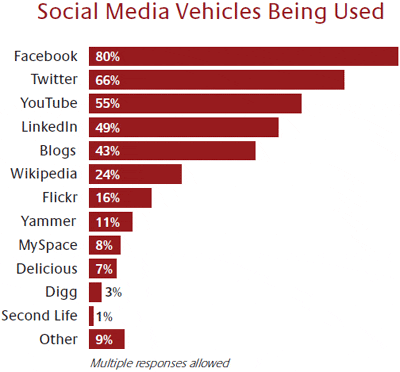
The most popular social networks being used include Facebook (80%), Twitter (66%), YouTube (55%), LinkedIn (49%) and blogs (43%).


Social Media Vehicles Being Used


"Particularly as Millennials compose a greater share of corporate ranks, social networks are likely to become more popular as communication channels with customers, colleagues and partners," said Carol Russell, CEO of Russell Herder.

The majority (74%) of executives said they visit social media sites at least weekly to read what customers are saying about their company, while 47 percent routinely monitor competitor's use of social networking. Over a third (36%) search social media sites to see what their employees are sharing and 25 percent use social networking to check the background of a potential employee.

"Social media is a far different animal than traditional technology, so a company's current policies on IT matters are usually not sufficient," said David Baer, President, Ethos.

"And remember, all companies are different, thus the rules for defining and implementing a social media policy are not universal. They must take into consideration the form, substance, philosophy and culture of the organization." (

READ MORE - Do you see value in social media or do you have serious concerns about it?

The conundrum facing publishers

The conundrum facing publishers. With their advertising revenue drying up, newspaper publishers spent much of the spring and summer debating whether to cut off free online access to some of the material they run in their shrinking print editions.

It looks like the talk will turn to action this fall, when some large newspapers are expected to put up Internet toll booths.

They'll be testing readers' willingness to pay for information and entertainment that mostly has been given away online for the past 15 years. That happened largely because most publishers could afford to subsidize their Web sites with profits from their print franchises. But now those profits have crumbled, just as the prices for online ads are tumbling, too.

A recent study by the American Press Institute found 58 percent of the responding newspapers are considering online fees. Of that group, 22 percent expect to introduce the fee before the end of the year. The findings drew upon 118 interviews of newspaper executives in the U.S. and Canada.

The free-to-fee transition likely will occur in tentative steps rather than bold leaps that would lock all online content behind a pay gate. Publishers are taking this cautious approach because they are still trying to devise online payment plans that will generate more revenue without alienating too many of their readers.

For instance, the Pittsburgh Post-Gazette, a newspaper with a weekday circulation of about 206,500, recently launched a Web site that includes coverage and commentary on sports, politics and entertainment that isn't in its printed product or free online edition. The service costs $36 annually or $3.99 per month.

Other newspapers that have talked up subscription plans remain reticent. Newsday of Long Island, N.Y., still hasn't rolled out fees for its Web site, even though the newspaper's owner, Cablevision Systems Corp., said it was going to do so this summer. Newsday spokesman Paul Fleishman declined to comment.

The conundrum facing publishers: It's hard to figure out how much, if anything, readers will be willing to pay. Internet search engines and digital communication tools such as Twitter and Facebook ensure people still will be able to find and share plenty of free content.

But running totally free sites hasn't been paying off for most newspapers. Even before the online market began to slump this year, Web ads were generating only a small fraction of the revenue that print ads do. The disparity has made publishers realize they need more ways to make money on the Internet, but few of them have been able to figure out how.

"This is like a four-dimensional chess game. It's really complex," said former newspaper editor Alan Mutter, who is now an industry consultant when he isn't writing "Reflections of a Newsosaur," a free blog.

The Associated Press also has been part of the online fee movement. The not-for-profit cooperative, which is owned by newspapers, is setting up a system that will track the usage of its stories. It's a crucial piece of a plan that could improve the AP's ability to run ads next to news stories and perhaps even lead the AP to charge readers to see major scoops or other "premium" content.

"The value of content has to rise," said Tom Curley, the AP's chief executive. "We are all looking how to make that happen."

Even as newspapers mull just how much to commit to charging readers, a competition is already brewing to provide the technology to enable it.

Four of the world's largest technology companies — Google Inc., Microsoft Corp., IBM Corp. and Oracle Corp. — have expressed an interest in developing an online payment system for publishers. Mutter also has been promoting his own approach to Internet fees, a concept he calls ViewPass.

Separately, more than 1,000 newspapers and magazines have signed nonbinding letters of intent to join an Internet fee system being assembled by Journalism Online LLC. It intends to begin collecting money on behalf of publishers before winter.

Backed by former leaders from Court TV and The Wall Street Journal, Journalism Online wants to run the cash register for a digital news smorgasbord. Readers will be able to buy stories from a wide range of participating publishers without having to repeatedly provide their credit card numbers and other personal information at each Web site. The content would be distributed on the Web and electronic reading devices, with each publisher dictating its own terms. As a commission, Journalism Online plans to keep 20 percent of the revenue collected through its system.

Although he isn't jumping on board with Journalism Online, News Corp. Chairman Rupert Murdoch is sold on online fees.

News Corp. already owns the newspaper industry's most successful Internet subscription model in The Wall Street Journal, with more than 1 million customers who pay for online access. The annual rates vary from $103 for an online-only subscription to $140 for a package that includes delivery of the print edition too. Now, Murdoch hopes to make online fees pay off for his other publications, which include the New York Post and The Times of London. Murdoch hasn't provided a timeline or specifics about his plans, however.

The New York Times is considering charging online readers a membership fee, with more details promised in the fall. It's a road the newspaper has been down before, only to reverse course after management concluded that the online subscription it required to read the Times' top columnists was crimping its Internet ad sales. The subscription service, which cost $50 per year, was scrapped in 2007 after a two-year run. It had 221,000 customers when the Times tore down the toll booth.

These days, the printed versions of newspapers are suffering so much that publishers appear determined to find a way to get readers on the Internet and mobile devices to pay something, even if it's just a few bucks per month. The question is mainly which publisher will jump off the sidelines first.

"There's still a lot of `wait-and-see' attitudes out there," said Randy Bennett, senior vice president of business development for the Newspaper Association of America. "I think a lot of publishers would like to see some empirical evidence of what happens to other publishers who dip their toes into the water."

In a worst-case scenario, imposing online fees would drive away so much of a newspaper's Web audience that publishers would lose more in Internet ad sales than they would gain in new revenue.

In a best-case scenario, newspapers charging their online readers would still retain enough of the audience for their Web sites to remain attractive marketing channels. What may be even more important, the fees might make readers more willing to pay for the print editions if the same content isn't on the Web for free, especially if print subscriptions include free or discounted Web access.

Preserving the value of their print franchises is one of the main reasons for publishers to charge for Web access. That's because newspapers still get most of their money from print ads, which accounted for $35 billion of the industry's revenue last year. Newspaper print ads are on pace to fall below $30 billion this year.

Online ads, in contrast, contributed just $3.1 billion in revenue last year. And while that category had been growing until this year, it wasn't fast enough to offset the erosion in print ads. From 2005 through 2008, the industry's annual revenue from print ads dropped by $12.7 billion. Meanwhile, newspapers' annual revenue from online ads increased by just $1 billion.

Journalism Online's co-founder, Steven Brill, believes newspapers can still hold on to most of their online readership by charging for only their best work — information, images and audio unlikely to be found anywhere else on the Web. This presumes publishers will be able to prevent the content from being copied and pasted or even just summarized at other sites, a potentially daunting task.

Some publishers still have no intention to charge for online access because they have concluded online fees are bound to backfire on the newspaper Web sites that adopt them, Mutter said. The American Press Institute study found 44 percent of the respondents don't think Internet fees will provide a significant lift to newspapers' future revenue.

"The guys who hold off (on Internet fees)," Mutter said, "could get a have a huge windfall in new traffic." [ AP ]

READ MORE - The conundrum facing publishers

Annoy Visitors At Your Website

Easy Ways to Annoy Visitors At Your Website. this is a satirical look at usability. Although it reads like a "Do" list, it is really a "Don't" list. If you follow it literally, your site is history.

1. Place some (or all of) your content in a small frame and force your visitors to read the content through that window. Don't worry about what constitutes "small" here, since most of the time, even if you create a big frame, it'll be considered too small by most visitors. This trick has a high annoyance value since your visitors have to view the information through that small little box and scroll continuously to see the text while the rest of the browser window is filled with information they don't really want to read at the moment. With this strategy, visitors cannot resize or maximize the window to make their reading more efficient or pleasurable. This method will allow you to frustrate those hapless souls and, as a bonus, make them leave your site.

2. Disable the right click menu of the browser. Nevermind that people need the right click menu for many purposes, and that they can access the same functions through the main menu bar even after you've disabled it. After all, if your aim is to annoy, you might as well make their visit to your site as unpleasant as possible.

3. Play background music when they arrive at your page. If that's not enough of an annoyance, make sure you loop the music so that the visitors are plagued by it continuously while they are on your page. If you're feeling particularly sadistic, place automatically-playing music on many (or even all) pages of your site. You don't have to worry about choosing a horrible tune - choose your favourite piece if you like. Since one man's meat is another man's poison, any sort of music tends to annoy most visitors.

4. Make every link on your site opens in a new window when your visitor clicks on it. That is, put a target="_blank" to every link. This will annoy visitors since every time they click on a link in your site, a new window or tab will open. Another benefit of this technique is that it makes your site look amateurish.

5. Force your visitors to navigate your website using Flash. That is, place all your content in a Flash file - text, pictures, links, etc - even if Flash is not ideal for such content (a straight HTML page is best for those types of content). Make sure that visitors who don't have the Flash plugin enabled or installed cannot see anything or do much on your website. This effectively drives away all mobile users, a group of users that is growing in size, as well as cripple your visitors who have come to expect certain facilities to always be available in their browsers (such as the BACK key and the ability to bookmark specific pages) when they visit websites. Now they will be forced to work through the more limited Flash plugin of their browser with whatever subset of features you deign to provide. In fact, exclusively using Flash for your site content might even help you to drop to the bottom of search engine listings too, thereby reducing the number of visitors to your site. After all, if you don't have visitors, you don't have to think of new ways to annoy them.

6. Load your site with pop-up windows that open when your visitor reaches your page as well as when they leave the page. In fact, if you want to annoy them even further, open a pop-up window when they click on links on your site.

7. Reduce the navigational usability of your website. Don't put site maps or navigation bars with shortcut links to pages that your visitors will usually want to go such as the "Download" page if you're a software author. If you can annoy your visitors by forcing them to read whole pages of your text before they can find a link to move on to do what they really want to do, so much the better.

There you have it. Seven quick ways that you can use to annoy, frustrate and irritate your visitors. They may even be effective in driving them away permanently. There are undoubtedly many other ways, but the methods listed above are easily doable by new webmasters.

WARNING: remember, the above is satire. It is a "reverse tutorial" if you will. You don't want to follow it.

[ thesitewizard.com ]

READ MORE - Annoy Visitors At Your Website

Optimize Your Blog For Bing

Optimize Your Blog For Bing. Bing is the most reviewed and discussed software of this year.It has been filled in news before it’s launching itself. Now it is one of the most used search engine and powerful opponent to even the giant Google.bing-seo-hack I think I don’t want to tell you that number peoples are using this search engine. Just think if you can get huge traffic from it. Interesting, isn’t it ? But don’t just dream that Bing will simply send visitors to your blog. You have to optimize your blog for Bing, then only you can get visitors from Bing. Anyway, No one has got that in what criteria Bing is ranking websites. But there are some little little tips we got about Bing. I have listed the TOP 7 – which have been approved by the whole web, in one voice.

1. Keywords In Domainseo.jpg

It’s heard that Bing is giving great importance to the keywords that are present in the domain name itself. So, bear this in mind while buying a new domain.

2. Age of your Domain

It’s approved that Bing is having more attraction towards old links. So try to buy an old domain, instead of registering a new one and being marked as a baby.

3. Size of the Content

Bing gives a great importance to pages with huge contents. A post with a 600 words could surely drive you a lot of traffic overnight.

4. Backlinks

Just as Google, Bing also use backlinks to measure your blog. Bing also gives a great importance to quality links. A good link could give you great authority than 100 bad links. Also bear in mind that bad links could effect your Bing rankings negatively.

5. Anchor Text

It seems like that Bing is having an eye on your anchor text too. So, don’t forget to use your killer keywords as your anchor text.

6. Page Title

In this case also, Bing shows similarity to Google. They are giving great importance to the page titles and the keywords in it.

7. Internal Links

Rather than counting the number of words, Bing is using the internal links on your site to calculate your keyword density. So don’t forget to give a link when you highlight your keywords.

There are so many other tips too, but these are the most useful and working tips. All these are simple and with these simple changes, you will be getting huge traffic !!! Isn’t it Interesting ?

So, make these changes on your blog, today itself. Enjoy……!!
[ devilsworkshop.org ]

READ MORE - Optimize Your Blog For Bing

Search Engine Traffic Percentages

Search Engine Traffic Percentages. A recent post in a discussion list suggested that Google is becoming the Microsoft of search (dominating web search as Microsoft dominates PC operating systems). So I decided to research a theory - one I'd developed about search engine traffic. I dug into the traffic stats on three of my own sites and those of several clients that I monitor traffic for.

While this case study is tiny and certainly NOT conclusive, I'll wager it has strong parallels across small business web sites. The conclusions drawn are admittedly opinion, based on very limited statistics, but those are all that matter to those of us seeing tiny search engine traffic from supposedly monstrous portals.

The participating clients from this case study ALL submit their sites to paid inclusion programs from AltaVista, Inktomi and AskJeeves/Teoma. Two use LookSmart LookListings and all but one are listed in YAHOO! Directory. All are listed in the Open Directory Project and all submit to smaller industry specific directories and smaller search engines. One uses Overture PPC on a limited basis, while none use Google Adwords. All were optimized by yours truly and each represent varied industries in retail, professional services and one is an information site only, is non- commercial and sells nothing. Each of them ranks well at most search engines, but see little traffic from those good rankings.

The research I did confirmed what I'd only assumed before by backing it up with solid numbers. On my own sites and those of clients that I reviewed, Google sends over 70% of all search traffic to every one of those domains in every case. This includes Google foreign variants, Google Directory and Google image search (image search numbers are tiny). The foreign Googles send tiny numbers of visitors from non-English speaking countries, but English speaking Google traffic from the UK, Canada and Australia drives more traffic than either Yahoo or MSN according to traffic statistics of those sites reviewed for this case study.

With the highest difference between compared search engine traffic of 8 percent variation between studied domains, I've compiled a list of average traffic delivered by search engines for those sites to which I have access to traffic logs. The Google percentages are inclusive of those portals that use Google results such as iWon.com and Yahoo web results. Direct Yahoo results are for sites listed in their directory.

Google 74% Yahoo 14% MSN 9% Ask 2% All other SE's 1%

I'm concerned, not that Google is too big, but that the other search engines just don't get it, don't deliver it and don't want to give it up. What is IT? Traffic!

I attribute this to one thing. Those search engines don't want to give up visitors to FREE search results. They are happy to send visitors off if they gain income from that traffic in either PPC ads or advertisements of ANY sort. Knowing that those free results will lose the "eyeballs" of searchers, they struggle to deliver both PPC ads and sponsor ads that most closely approximate the search phrase entered by the searcher. Thankfully, all have dropped banner ads from the SERP's (Search Engine Result Pages).

They cannot stand the idea they will lose the visitor and seek to entice them to click on something, anything that'll earn them income. Even if it means delivering NON-relevant results to entice the searcher to use a different search phrase seeking to gain more relevant results, thereby viewing more ads and additional PPC ads the visitor may click on to deliver income to the portal.

I believe these search engine traffic percentages are a direct reflection of relevance delivered by those search engines. The more relevant the results, the more likely they'll send a higher percentage of traffic to your site.

74% of search traffic referred: Google offers their own PPC results, offers no outside banners, Amazon links or effluvia related to the search. They deliver relevant results and visitors love that, then leave freely to return next time they want relevant results.

14% of search traffic referred: Yahoo offers Overture PPC results (which they'll soon own), Amazon links and sponsorship links, along with that "Also search in: Yahoo! Shopping" link at the bottom of every result page, hoping you'd rather shop than to actually find what you were searching for!

9% of search traffic referred: MSN offers Overture PPC results, "Broaden your Search" (LookSmart) links, "Shopping Results on MSN" links and a sponsor text link at the bottom of every page as though you didn't really want to find anything but their ads.

2% of search traffic referred: Ask offers more paid results than any other search property with 5 sponsor links at the top of every search result page and TEN links to further paid sponsor results in a "Related Searches" footer to every result page. Ask sponsors provide search ads. Doesn't Ask understand that most searchers see right through this?

Relevance at each of these search engines declines further with progress down the list of traffic referred. Is it any wonder Google is the leader? They lead in relevance, therefore in search engine referred traffic. All any engine need do is provide relevant results with limited sponsors and no excessive "shopping" or multiple source PPC links and book links. If they do that, they'll compete effectively with Google. More relevant search engines deliver the traffic to web sites, NOT to their advertisers.

I have a bold suggestion to make to MSN as they develop their new in-house search engine. Drop the ads, sponsors, book links, shopping links and resist the temptation to bring back banner ads. Searchers want to find what they are looking for and easily see through transparent attempts to sell stuff to them and keep them from leaving. Let go of searchers by delivering highly relevant search results while clearly labeling limited numbers of sponsor or PPC ads! The result will be devastating to Google by giving searchers a real alternative that they may prefer using!

YAHOO! has a huge task ahead of them - to integrate the recently acquired Inktomi, Overture (and Overture's recent acquisitions Altavista and Fast/AlltheWeb) search technology into their search mix. Clearly they've plenty of technology now and won't need Google when they add all these ingredients to the search soup they are cooking up. Yahoo will possess all the best technology and must only decide to provide relevant search results WITHOUT shopping links, excessive sponsor links, book links and other clutter to the SERP's. I suggest that if they show only limited Overture PPC ads and clearly labeled sponsor ads along with the relevant results - that they can also threaten Google's lead.

If the re-born, re-cooked and massively complex YAHOO! or the "new" MSN resist the temptation to send searchers to advertisers rather than sending them to relevant results, then we will have three very strong competitors in the search market. The numbers of search referrals will level off at about 30% per competitor and Google will have to fight to gain back their current dominance. If YAHOO! or MSN seek to favor advertisers over searchers, Google will maintain dominance - clear and simple.

I encourage all webmasters to do their own comparisons of traffic referrals now and then again when YAHOO! and MSN weigh in over the next year with their "new" offerings. It could get very interesting if there were some true competition in search, so referred traffic from YAHOO! and MSN starts to deliver to webmasters rather than advertisers.

READ MORE - Search Engine Traffic Percentages

Tips and Tricks to Optimize Your Website Content

Tips and Tricks to Optimize Your Website Content. We all know that search engines are very important for the success of a website. Almost 85% of new internet users find good websites by using a reliable search engine like Google.

Search engines like Google fight to index thousands of pages of content found on the internet in the right order depending on several characteristics.

Search engine algorithms may vary with time but you can ensure that you have a website that is filled with SEO optimized, original content so that your page ranks as high as possible on the search results.

The following explains best 5 tips about SEO optimizing your web page:

Appropriate landing page

Apart from finding a great niche and product, it's also necessary to have a targeted landing page to encourage paying customers. And one great tip I've found is that to ensure your landing page does not sell anything at all!

In fact, it should give a valuable resource away for free like a niche e-book, newsletters, mini-course and even tele-seminars that will educate the customer about the value of your product. Not only does it raise customer awareness but it also encourages customers to buy what you will eventually show them!

Fresh content

Fresh and new content updated daily is one way to ensure that Google keeps returning to your page again and again. Once the search algorithms are trained to realize that the content on your page changes daily and is completely original you are more likely to see your website higher up in page rankings.

SEO optimizing!

You also have to ensure that the content is SEO-optimized. This is possible by using Keywords that are recognized by search engines as related to your product.

Fill your content with an average of 2% of Keywords per page of 100 words. That means your page should run an average of 10 Keywords in a page of 500 words. Do not put in more than that as search engines tend to classify high keyword pages as spam or duplicated content.

Create a lot of internal links where a single article links to another archived articles in your blog or the site itself. This will increase site recognition and page rankings.

Keeping them simple

Don't flood your site with complex codes like Flash, Ajax, etc. Of course, the site will look great but this just tends to slow down your site and as a result might prevent search engines from crawling and indexing your website properly.

Arranging the Keywords can make or break a website!

Start strong by adding your keywords in the first paragraph and the very first line and the first line of the last paragraph. Search engines like this as it makes it easier for them to classify the article, site and content.

Try to use lateral semantic indexing where you use the same keywords in the form of plurals or related variations. The more the number of variations you put in, the better the page ranking.

There you have it.. The most important thing of all is to take action.

READ MORE - Tips and Tricks to Optimize Your Website Content

Tips for Managing the Website

Tips for Managing the Website. Tips for a Successful Website. A successful website is something that everyone venturing into the new arena of Internet marketing and communications wants to have. Your website will often be a potential client's first impression of you and your business. That being said, it is vitally important that your website represent you in a favorable manner. Your website is a component of your overall marketing strategy and should be reflective of your business and current marketing presentation. Just as your brochures and other print materials represent a level of quality and professionalism, your website should also represent that same level of quality and professionalism. As a point of comparison, you most likely wouldn't have just anyone design your company's marketing materials or for that matter, prepare your tax statements. Similarly, it is important that the person creating your website know how to effectively communicate both your message and style, and be able to create an effective experience for those visiting your site.

What does it really take to have your website be successful, and what are some of the most important steps you can take to make that happen?

1. If you intend to have a unique domain name for your website, you must first check to see if it is available. You can check to see if a domain name is currently registered at http://www.internic.net.

2. Set a budget for your website. It is important to know how much you can spend on your project. In considering costs, remember that a website is a complex matrix of text and images and a professional execution is very important. As a generalization, the larger your investment, the greater your return. In order to spread your investment over time, you can also grow and expand your website gradually. Don't forget to include costs for promotion and advertising.

3. Determine the purpose for your website and the intended results. Does this purpose support the mission and vision for your company? The number of options and variables that are possible in the design of a website are virtually endless. Without a clear idea of the purpose for your website, you may end up putting time, energy, and money into a project which doesn't meet your needs. If you know in advance the results you intend to achieve, you will be better equipped to create a website which will achieve those results.

4. Consider the design and layout of your website. Is it easy to use? Does it take too long to down load? Is it easy for Internet visitors to find information? Does it meet the needs and expectations of your visitors? Several smaller pages eliminating the need for scrolling are often more effective than one long page. If an Internet visitor doesn't have a positive experience of your website, she/he probably won't return, or won't tell someone else about it. An effective website often creates a reason for the visitor to return. This reason can take the form of unique information that changes on a regular basis, interesting and useful resources, or a way for visitors to communicate with you or with each other. Use your website to build a relationship with your Internet audience.

5. Promote, promote, promote. No one will find your site if you don't let them know about it. Your site must be posted to search engines such as Lycos, Yahoo, and Excite. There are approximately 20 to 30 main search engines and several hundred that are smaller or specialized. You can find an extensive list of website submission sites, services, and resources at http://dir.yahoo.com/Computers_and_Internet/Internet/ world_Wide_Web/Announcement_Services/

Include your website address on all your marketing materials; business cards, and advertising; you can even paint your address on the side of a company vehicle. The idea is to have as many people see your site address, and thus your website. You may also consider hiring a publicist to help you get the word out.

6. If at all possible, begin your website now. The companies which have been on the Internet the longest are those which achieve results sooner. If you are in an industry which isn't widely represented on the Internet yet, so much the better - you'll be able to start off with a larger market share. It's estimated that there are about 200 million people using the internet with 75% of the in North America. Start your Internet presence today!

READ MORE - Tips for Managing the Website

Website Promotion

Website Promotion. Website promotion is an integral part of running a successful online business. Promoting your site on the internet follows the similar principle to promoting any business, listing you business in business directories, making sure people know about your business, news letter drops etc.There is one main benefit of Internet promotion and promoting your business on the internet, it can and will happen much quicker than offline!

So, where to start? Once your site is complete (and I mean 100% complete) you need to begin your internet promotion campaign.

Search Engine Submission :


Submitting your website to search engines is an effective way of driving qualified traffic to your website. What better way than attract a proactive audience, people are actively searching for your products. Addme provide a variety of search engine submission services, all available from the submission section of the site.

Directory Submissions :


Though not as effective, internet directories are also a good source of traffic and backward links (Backward links are beneficial for your search engine rankings). When compiling your list of directories make sure you have www.dmoz.com and Yahoo!.com at the top of your list!

Search Engine Optimization :


During completion of the above to practices we strongly recommend that you also start optimizing your website for search engines. Search engine optimization is an integral part of internet website promotion. Unfortunately simply submitting your website to a search engine will not get you top position – you will be required to make sure that the copy on the WebPages is unique. The copy should also included popular search terms that people will use to search for your products and service. To find out what people are searching we recommend using Keyworddiscovery.Finally, you will need to make sure that your site can be accessed by a search engine. Check out SEO Toolkit for all the required tools to complete your website optimization.

Paid Search :


Paid search marketing (aka CPC) is a very effect way to drive targeted traffic to your website. Many search engines offer a paid search program, the biggest ones being Google, Yahoo! And more recently MSN. Paid search listings generally receive 30% of the search traffic from a search results page. Paid search programs allow you to nominate what search terms you want your site to show up for. Other main benefits of paid search campaigns are:

  • Day Parting; Nominate the time of day when your ad/listing is shown
  • Geo - targeting: Target your paid search ad's to certain geographical location ( s)
  • Target Pages: Drive traffic to specific pages on your site, this is done during the ad group set-up. You can even drive traffic to specific pages depending on the search term.
  • Positioning: To limit your search spend and manage the flow of traffic you can specifically position your paid search add.

Trusted Feed :


The final search product available to increase your presence in the search engine results is trusted feed. Trusted feed is a hybrid search product combining natural listings within the Yahoo! Search results with a flat bid structure depending on your category. This form of search marketing works very well for sites with a large volume of pages i.e. shopping websites.

Email Marketing :

Another effective form of website promotion would be email marketing. Known as a more aggressive form of marketing, email marketing involves building or acquiring an opt in mailing list. This mailing list must suit your audience and MUST be opt in. if you purchase a mailing list that is not opt in you will do more harm than good, you will be send emails to people that did not request these , thus risking your site being black listed for spam. Another very important point to consider when purchasing a mailing list is the audience; make sure you're not wasting your message on people that are not interested in what you have to say.

Combining the popular methods of website promotion, search engine submissions, directory submissions and email marketing is a step in the right direction to promoting your website, building brand and driving traffic to the site via search engines.Finaly, website promotion is an ongoing project. Like any other form of promotion - you need to keep at it for it to work.

READ MORE - Website Promotion